


The old starting line moved.
Before, you learned by making the messy first version yourself. You got corrected. You fixed it. You slowly built a sense of what good looked like.
Now AI can hand you something that looks finished before you even know whether it is good. That is not progress for beginners. That is a trap.
I’ve been building for the web since 2000, across development, UX, QA, DevOps, project management, teaching, and marketing. So when I say output is not the same as quality, I’m not saying it from theory. I’m saying it from years of watching work ship, break, get fixed, and become better.
People keep telling new grads to “learn AI.”
Okay. But learn what exactly?
Prompting? Chatbots? Agents? Automation? Image generation? Coding tools? Research tools? Which tool? For what work? Under what standard?
This is why a lot of AI career advice feels useless. It sounds urgent, but it does not give beginners a real place to stand.
AI can now do many of the tasks beginners used to practice on.
First drafts. Simple summaries. Basic code. Mockups. Reports. Email replies. Slide decks. Marketing copy. Research outlines.
The evidence points the same direction.
PwC’s 2026 Global AI Jobs Barometer — based on over a billion job ads across six continents — found that entry-level roles most exposed to AI are now seven times more likely to require skills traditionally expected of senior workers: leadership, judgment, decision-making.
That is not a warning. That is a signal.
AI is not simplifying the human part of the job. It is raising the floor on what the human part needs to be.
Which means the question is not whether AI will touch your work. It will. The question is whether you are building the skills that sit above what AI can do on its own.
A clean-looking output is not the same as a correct one. A confident answer is not the same as a true one. A pretty mockup is not the same as a usable interface. A working demo is not the same as a solved problem.
So no, I don’t think the most important beginner skill is “prompting.”
Prompting matters, but prompting is not the whole job.
The real skills are older and more stubborn:
Judgment. Taste. Verification.
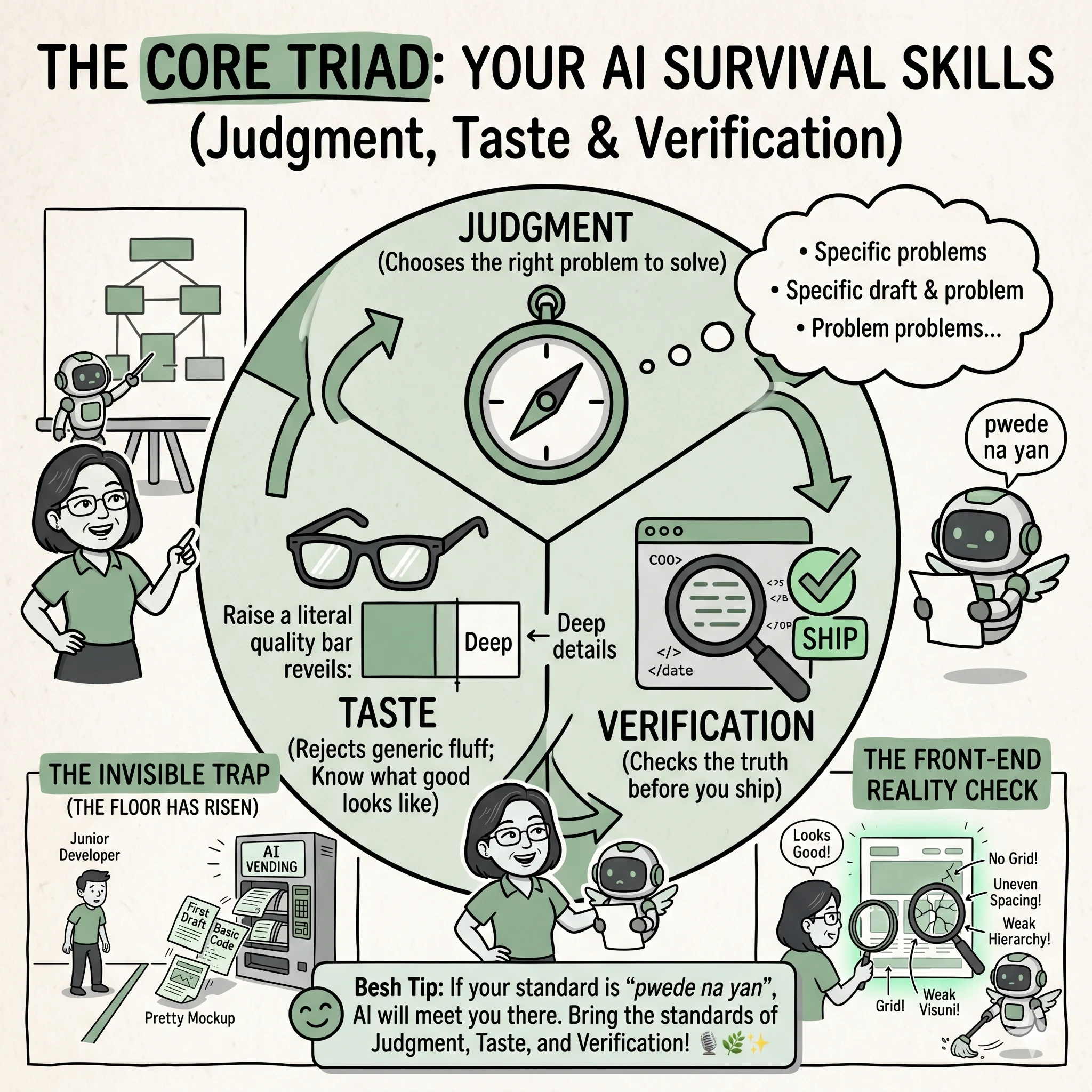
Judgment is knowing what matters. Taste is knowing what good looks like. Verification is checking if the thing is true, useful, and safe to ship.
That is the part people skip when they treat AI like a vending machine.
The friction: AI moved the starting line
A lot of new grads are not just afraid that AI will replace them.
They are afraid that AI has removed the practice ground.
And honestly, that fear makes sense.
Entry-level work used to include many small tasks that helped you build skill. You learned by doing. You learned by getting things wrong. You learned by seeing how your rough version compared to someone better.
But AI can now produce the rough version very quickly.
That sounds helpful, until you realize the beginner still needs to know how to judge the output.
If AI gives you a design, can you tell if the spacing is bad?
If AI writes code, can you tell if it is solving the wrong problem?
If AI summarizes a report, can you tell what it missed?
If AI gives you a marketing plan, can you tell if it is just generic fluff wearing a business costume?
If AI makes a poster, can you tell if the layout has balance, hierarchy, readable type, and proper contrast?
This is where many people get stuck.
AI gives them something that looks “okay.”
And if they don’t have a trained eye yet, “okay” becomes the standard.
Because AI does not only speed up excellence.
It can also speed up “pwede na yan.”
“Pwede na yan” is a Filipino phrase that roughly means, “That will do.”
Sometimes it is practical. Not everything needs to be perfect. People have deadlines, budgets, tired brains, and real constraints.
But sometimes “pwede na yan” becomes a habit of settling. It means stopping at “good enough” before asking if the work is clear, useful, accurate, or well-made.
In this article, I’m not using it to shame people.
I’m using it to name a missing bar.
Because if nobody has shown you what good looks like, “that will do” can quietly become your standard.
The evidence: the task changed, but responsibility did not disappear
Recent workplace reports keep pointing to the same thing:
AI is changing the shape of work, but human skill still matters.
A few useful signals:
- World Economic Forum, Future of Jobs Report 2025: AI and big data are growing fast, but human skills like creative thinking, resilience, flexibility, and agility still matter.
- PwC, Global AI Jobs Barometer 2026: PwC analyzed over a billion job ads globally. In its U.S. entry-level analysis, roles most exposed to AI were seven times more likely to require traditionally senior human skills like leadership, creativity, or face-to-face interaction.
- Microsoft, Work Trend Index 2025: The workplace may become more AI-operated, but the strongest version still has to be human-led.
That last part matters.
AI-operated does not mean human-abandoned.
Someone still has to set direction.
Someone still has to check the work.
Someone still has to notice when the output is wrong, bland, risky, ugly, confusing, or solving the wrong problem.
The tool can produce.
But the person still has to decide what deserves to move forward.
The model: judgment, taste, verification
Here is the simple model I would give to any new grad:
Judgment chooses the target. Taste raises the bar. Verification checks the truth.
You need all three.
Judgment chooses the target
Judgment is when you stop asking AI to make more stuff and start asking:
Should this even exist?
What problem are we solving?
Who is this for?
What matters most?
What should we not ignore?
AI can generate a lot of motion. That does not mean it is moving in the right direction.
It can write a detailed plan for the wrong problem.
It can create a feature nobody needs.
It can make a polished email that avoids the actual issue.
It can give you five options when the real answer is, “Pause. We need better context.”
Judgment is what keeps AI from turning work into noise.
Taste raises the bar
Taste is harder to explain because people often think it means personal preference.
It is not just preference.
Taste is trained judgment.
It is what lets you look at something and say:
This is technically correct, but not good.
This is pretty, but confusing.
This sounds professional, but it says nothing.
This layout is busy.
This font pairing is fighting.
This line height is cramped.
This color choice makes the important thing harder to see.
This interface has no hierarchy.
This poster has no balance.
This output looks finished, but the thinking is weak.
Taste is not magic.
Some people may have a natural eye for it, but taste can absolutely be learned.
You build it by looking at better work. You build it by comparing versions. You build it by asking why one thing feels cleaner, clearer, stronger, or easier to use than another. You build it by getting corrected. You build it by refusing to stop at “pwede na yan.”
And this is where I think a lot of us in the Philippines have a real challenge.
Not because Filipinos lack talent. We have talent everywhere.
But many people were never shown the bar.
You can see it in everyday posters, school announcements, barangay graphics, small business menus, tarpaulins, event materials, and public-facing documents. Many of them are made with effort. Many are made by people trying their best. But you can also see the lack of design training: too many fonts, weak spacing, no grid, poor contrast, no hierarchy, elements fighting for attention.
I don’t say that to demean the people making them.
I say it because taste requires exposure.
If nobody teaches you what good layout looks like, if nobody explains spacing, alignment, hierarchy, typography, contrast, and composition, then you may honestly look at weak work and think, “Okay na yan.”
That is not a character flaw.
Nobody showed them what good looked like.
AI makes this more urgent because now people can generate more output faster. But faster output does not automatically create better taste.
If your standard is low, AI will help you produce low-standard work faster.
That is why taste matters.
Taste is the bar you bring into the tool.
Verification checks the truth
Verification is the discipline of checking before you trust.
AI can be useful and wrong at the same time.
It can sound confident while inventing details.
It can follow part of your instruction and miss the actual point.
It can give code that works once and fails later.
It can create a nice-looking image that ignores the most important requirement.
It can summarize a document but leave out the paragraph that changes the decision.
Verification asks:
Is this true?
Where did this come from?
Can I test it?
Does this match the source?
Does this work in the real environment?
What breaks if this is wrong?
What would I refuse to ship as-is?
Verification is not a boring final step.
In an AI world, verification is part of the job.
The story: when “looks good” is not good enough
I keep seeing this with AI-generated front-end work.
The output can look fine at first glance.
A page loads. The buttons exist. The colors are there. The text is readable. Nothing is obviously broken.
So the AI basically goes, “Looks good.”
But when you inspect it with a trained eye, the cracks show up:
- The layout has no real grid.
- The spacing is uneven.
- The visual hierarchy is weak.
- The typography is fighting itself.
- The line height feels cramped.
- The color choices do not guide the eye.
- The important action does not stand out.
- The page has no balance.
This is why AI struggles with front end.
Front end is not just “put boxes on a screen.”
It is taste, structure, usability, and restraint.
It is knowing why one button should be more visible than another.
It is knowing why alignment matters.
It is knowing when the user’s eye has nowhere to land.
It is knowing that “technically present” is not the same as “designed well.”
And you only build that skill by looking, comparing, practicing, and being willing to say:
No. This is not good enough yet.
The field note: AI can produce output, but it does not automatically know the bar
From building with AI tools, managing dev work, debugging outputs, and testing AI-generated images and interfaces, this is the pattern I keep seeing:
AI is good at generating a first version.
Sometimes the first version is useful.
Sometimes it is impressive.
Sometimes it is confidently wrong.
Sometimes it is beautiful nonsense.
The danger is not that AI gives bad output.
The danger is when the human cannot tell.
That is why beginners should not only practice prompting.
Practice inspecting.
Practice comparing.
Practice asking what is missing.
Practice asking what would make the output fail.
Practice asking whether the work solves the real problem or just looks busy.
Practice raising the bar.
Because the bar matters.
If your standard is “pwede na yan,” AI will meet you there.
If your standard is clearer, sharper, more useful, more tested, and more honest, AI can help you get there faster.
But you have to bring the standard.
The practical next step
Here is a simple exercise.
Pick one AI output.
It can be a poster, resume bullet, email draft, research summary, landing page, small app, spreadsheet, or social media post.
Save the first version.
Then review it in three passes.
Pass 1: Judgment
Ask:
What problem is this solving?
Who is it for?
What matters most?
What should this not do?
Is this even the right output?
Pass 2: Taste
Ask:
What looks generic?
What feels unclear?
Where is the hierarchy weak?
What is crowded?
What is distracting?
What would make this cleaner, clearer, or easier to use?
What would someone with higher standards change?
Pass 3: Verification
Ask:
What claims need checking?
What facts need sources?
What assumptions need testing?
What could break?
What would I refuse to ship?
Then make a second version.
Save the before and after.
Write five bullets explaining what you changed and why.
That is a receipt.
And when everyone can generate output, receipts matter.
The goal is not to prove you did everything manually.
The goal is to prove you can think.
AI did not erase the beginner.
But it did make the beginner’s blind spots louder.
So if you are starting your career now, do not stop at “learn prompting.”
Learn judgment.
Build taste.
Practice verification.
That is how you become someone who can be trusted with the work.