


AI researcher Andrej Karpathy posted something today about a “growing gap” in how people understand AI capability. I read it and thought: yeah, I’ve been living on the far side of that gap for a while now. Welcome to the party, everyone.
I’m not saying that to be smug. I’m saying it because if you’re just now clocking what’s possible — today, from that tweet, from a friend who won’t shut up about it — that’s actually great timing. The tools have never been better. And the gap is very crossable.
This is The $20 Psychosis — a series about crossing that gap without a corporate budget.
What Karpathy Actually Said (And What He Missed)
Here’s the gap he described. There are two types of people right now:
Group A tried free ChatGPT ChatGPT at some point, saw it fumble something embarrassing, and quietly filed AI under “overhyped.” They’re not wrong about what they saw. They just saw the wrong version of it.
Group B is using professional AI tools for real technical work — coding, math, research. This group, Karpathy says, is experiencing something he calls “AI Psychosis.” Because the things they’re watching AI do are hard to believe. You hand a terminal to one of these models and watch it “melt programming problems that you’d normally expect to take days or weeks of work.”
Here’s where Karpathy and I part ways: he frames this as a $200/month phenomenon. Enterprise tier. Corporate budget.
I’ve been on the $20 tier this whole time. Still seeing the melt.
And I’ve been doing this long enough that I thought I was just doing what made sense — until I realized most people around me hadn’t made the jump yet. What I was calling “my workflow” turns out to have a name now: agentic engineering. I just didn’t have Karpathy’s vocabulary for it yet.
Welcome to The $20 Psychosis. This is Part 1 of a series about how to get there yourself — no corporate budget required.
Why Code Is Different From Everything Else
Here’s the thing that makes AI so powerful for technical work specifically — and this matters whether you’re a developer or not.
When you ask AI to write you a blog post, “good” is fuzzy. It depends on your voice, your audience, your opinion. The AI has no way to know if it got it right.
But when you ask AI to fix broken code, the answer is binary: does it run or doesn’t it?
This is called a verifiable reward — a clear, objective measure of success that the AI can check for itself. No guessing. No subjectivity. The terminal either says Build successful or it throws an error.
That’s why AI has made such dramatic leaps in coding specifically. It can try something, see the result, adjust, and try again — like a very fast, very tireless junior developer who never gets frustrated and never needs a coffee break.
The same logic applies to math (is the answer correct?), to tests (do they pass?), and to many kinds of structured technical problems.
If you’ve been using AI only for writing or brainstorming and wondering why you’re not seeing the magic — this is why. You’ve been fishing in a pond when there’s an ocean right next door.
The Gap Is Money. And Also Not Money.
So if the magic is real, why isn’t everyone seeing it?
Let’s be honest about this, because most people aren’t.
Money does matter. The $200/month tier is real and it buys you something concrete: a bigger pool of tokens. More compute. Longer runs. The ability to just throw tokens at a problem until it breaks open. Corporations buy it because their developer time costs more than $200/month — it’s pure math for them.
But here’s what the higher tier doesn’t buy you: the ability to think.
When you’re on the $20 tier, you can’t afford to be sloppy. You can’t just dump your entire codebase into a prompt or an agent skill and hope for the best. You have to be scrappy. Resourceful. A little creative about how you frame the problem. You have to show up with your brain already engaged — and it turns out, that’s actually a better way to work with AI anyway.
The $200 path is brute force. The $20 path is craft.
And craft, combined with the right interface, gets you to the same place.
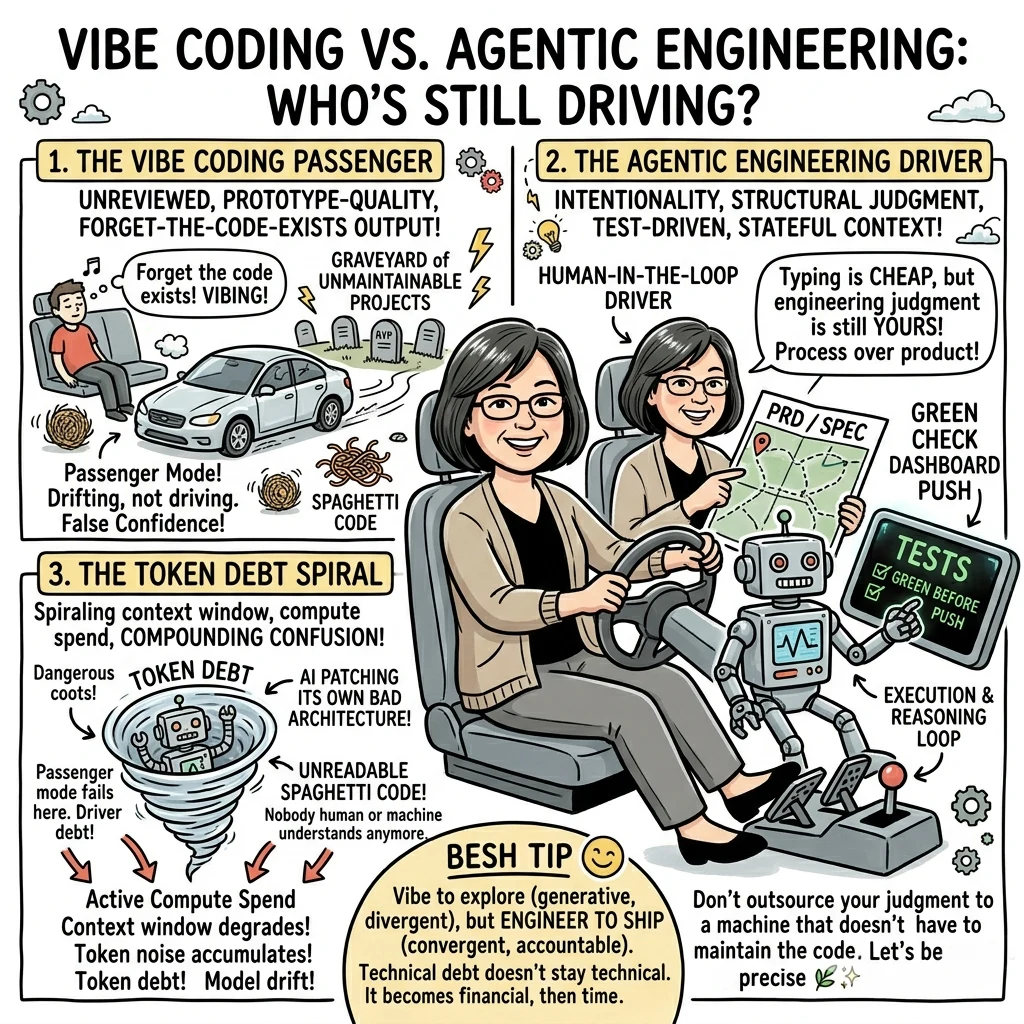
That interface matters too. The chatbot experience — type a question, get an answer, copy-paste — is like watching someone else drive. You’re a passenger. The AI can’t touch your files, can’t run your code, can’t see what actually happens when it tries something.
The operator experience is when you give the AI a steering wheel. When it can actually do things in your environment, not just describe what it would do. That’s available at the $20 tier. You just have to be intentional about how you use it.
Before you let AI loose on anything significant, spend 5 minutes writing down what “done” looks like. What does the finished thing do? What should it not do? What would make you say “yes, that’s it”?
That clarity is your secret weapon. When the AI has a precise target, it’s a little scary how often it hits it — even on a budget.
You Don’t Need $200/Month to Cross the Gap
Here’s the part that made me feel a little less broke and a lot more capable.
The $200/month tier exists. It’s real. It unlocks more compute, longer sessions, priority access during peak hours. Corporations buy it to save their developers time, because their developer time costs more than $200/month.
But the thinking behind it? The mindset? The workflow? That’s not behind a paywall.
You can run Claude Code on a $20 Claude Pro subscription. You can use Codex. You can point these tools at your terminal, your file system, your actual project — and watch what happens.
What you need isn’t more money. It’s a better operating system for how you work with AI.
That’s what this series is about.
The $20 Architect’s CLI Toolkit (2026)
| Tool | Primary Provider | Killer Feature | Entry Cost | Link |
|---|---|---|---|---|
| Claude Code | Anthropic | Plan Mode & Multi-Agent Teams | $20/mo (Pro) | claude.ai/code |
| Codex CLI | OpenAI | Sandboxed Safety & Speed | $20/mo (Plus) | openai.com/codex |
| Gemini CLI | 1M+ Context & Search Grounding | $20/mo (Advanced) | gemini.google.com | |
| Aider | Open Source | Git-Native & Model Agnostic | Free (BYO API Key) | aider.chat |
| OpenCode | Community | Local LSP & Privacy First | Free (Ollama/Local) | opencode.dev |
Note: Entry cost refers to the base subscription that unlocks the API/CLI capabilities. Usage fees may apply for high-volume tasks.
That’s what this series is about.
What’s Coming Next
In Part 2, we’re going hands-on. We’re going to move you from the chatbot passenger seat into the operator’s chair — and I’ll show you exactly what changes when you do.
No advanced degree required. No enterprise subscription. Just a terminal, a clear head, and the willingness to watch something melt.
Stay scrappy. Stay sovereign. 💚
The Vibe Coding Series is a practical guide to crossing the AI capability gap on a budget. New parts drop weekly.