


Garry Tan just open-sourced GStack — his personal Claude Code setup that turns AI into a virtual engineering team. 26K stars. 3K forks. Trending everywhere. And for good reason — the engineering workflow is solid. Separate your planning from your review from your shipping. Give the model distinct roles instead of one mushy mode. It works.
But here’s the thing.
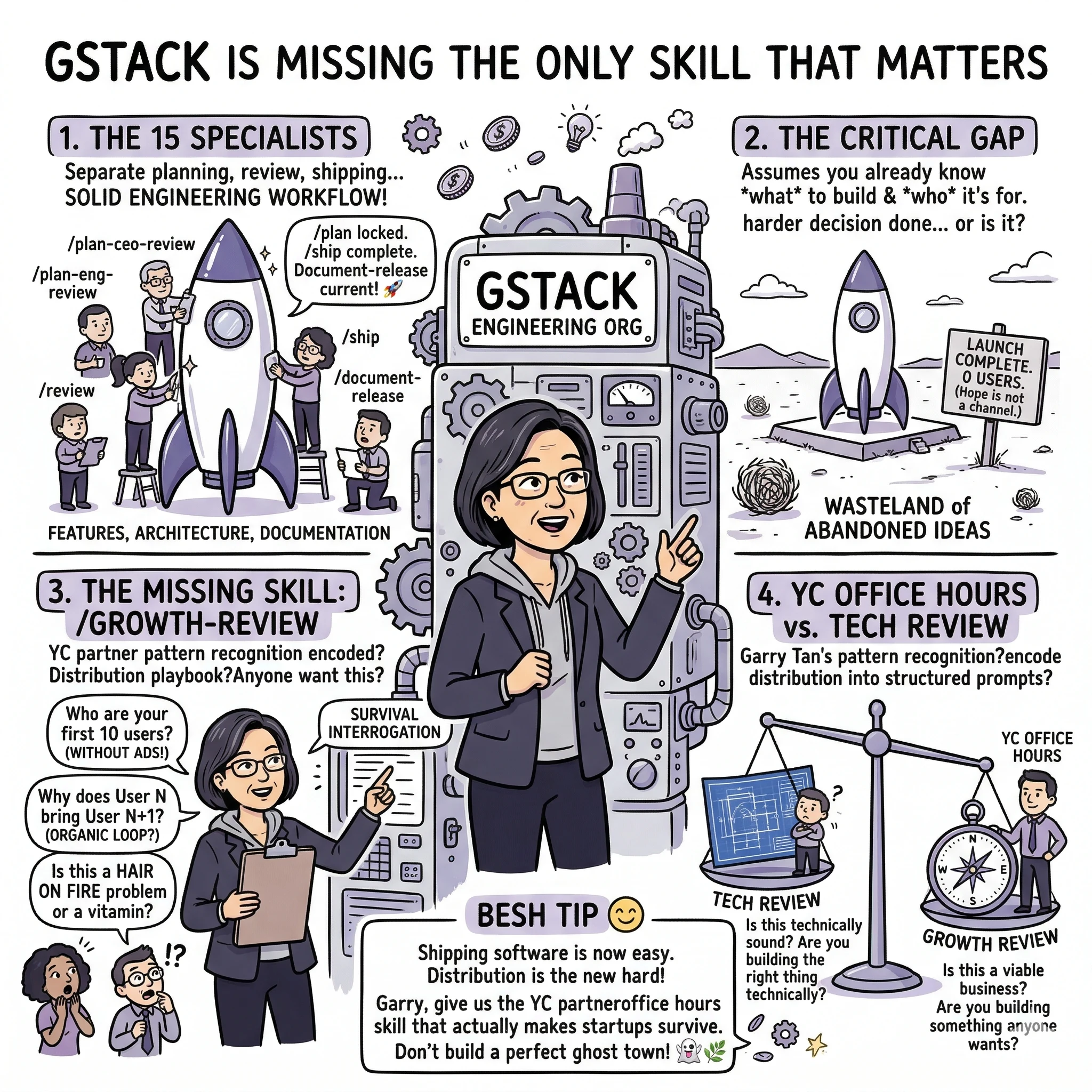
Every skill in GStack assumes you already know what to build and who it’s for. The entire stack kicks in after the hardest decision has already been made.
There’s /plan-ceo-review for scoping features. /plan-eng-review for locking architecture. /review for catching bugs. /qa for testing. /ship for pushing code. /document-release for keeping your docs current. Fifteen specialists covering every phase of engineering execution.
Not a single one asks: “How will anyone find this?”
The Gap
/office-hours is the closest thing to strategic thinking in GStack. It’s named after the most legendary ritual in startup culture — YC office hours, where partners sit across the table from founders and ask the questions that kill bad ideas early.
But the skill doesn’t do what real office hours do. It reframes your feature. Real YC office hours reframes your business. The skill asks “are you building the right thing technically?” A YC partner asks “are you building something anyone wants, and how will they find you?”
That’s a fundamentally different question. And it’s the one that actually determines whether your project lives or dies.
The Skill Nobody’s Built Yet
Imagine a /growth-review that interrogates your go-to-market the way /review interrogates your code:
- Who are your first 10 users and how are you reaching them without paid ads?
- What’s your organic loop — why does user N bring user N+1?
- Is this a “hair on fire” problem or a vitamin?
- What’s your activation metric? Now what’s your retention?
- What do you know about this market that nobody else does?
- Why now — what changed that makes this possible today?
Or a /distribution-audit that pressure-tests your channels:
- You’re building a dev tool. Where do devs actually discover new tools? Are you there?
- Your landing page exists. What’s driving traffic to it? Hope isn’t a channel.
- You have a free tier. What’s the conversion trigger to paid? When does it fire?
These aren’t engineering questions. They’re survival questions. And they’re the ones that 90% of builders — especially technical builders who are great at shipping — never ask early enough.
Why Garry, Specifically
This isn’t a generic feature request. Garry Tan is arguably the single best person alive to build this skill.
He’s sat across the table from thousands of YC founders. He’s seen the patterns — what gets traction, what distribution channels work at what stage, what “do things that don’t scale” actually looks like in practice, when to pivot versus double down. That pattern recognition took decades to build. It’s rarer than any engineering workflow on earth.
GStack already proves he knows how to encode tacit knowledge into structured prompts. The /office-hours skill demonstrates the format — forcing questions, premise challenges, alternative approaches. The architecture is there. The engineering playbook is there.
What’s missing is the growth playbook.
And that’s the one nobody else can write. Any senior engineer can build a code review prompt. Only someone who’s helped launch Coinbase, Instacart, Stripe, and thousands of other companies from zero to product-market fit can encode what he knows about distribution into a skill that asks the right hard questions at the right time.
The Real Bottleneck in 2026
We’re in an era where one person can ship 10,000 lines of production code per day. Garry proved that himself. The engineering bottleneck is dissolving.
But shipping isn’t the hard part anymore. It never really was. The hard part is building something people want and making sure they find it. That gap is wider than ever — because now everyone can ship fast, which means the market is noisier, and distribution matters more, not less.
GStack is an excellent answer to a question that’s becoming less urgent every month. The models get better at code every release. The question that’s getting more urgent — “I built it, now what?” — has no skill for it yet.
Garry, you gave us the engineering org. Now give us the YC partner office hours that actually makes startups survive.
The repo’s MIT licensed. The format’s proven. The knowledge is in your head. /growth-review is the skill only you can write.
Explore the Framework
These concepts are part of a broader framework for building intent-aware AI systems. I've distilled these strategies into a short, practical guide called Thinking Modes.
View the Book →I’m Carmelyne — a previously US-bound solopreneur now building AI products in the Philippines. I’ve been shipping software for 25+ years. GStack’s engineering workflow is solid. But after decades of building things, I can tell you: the hardest bug to fix is the one where nobody shows up.